
Risks
Risks measured, treated and monitored.
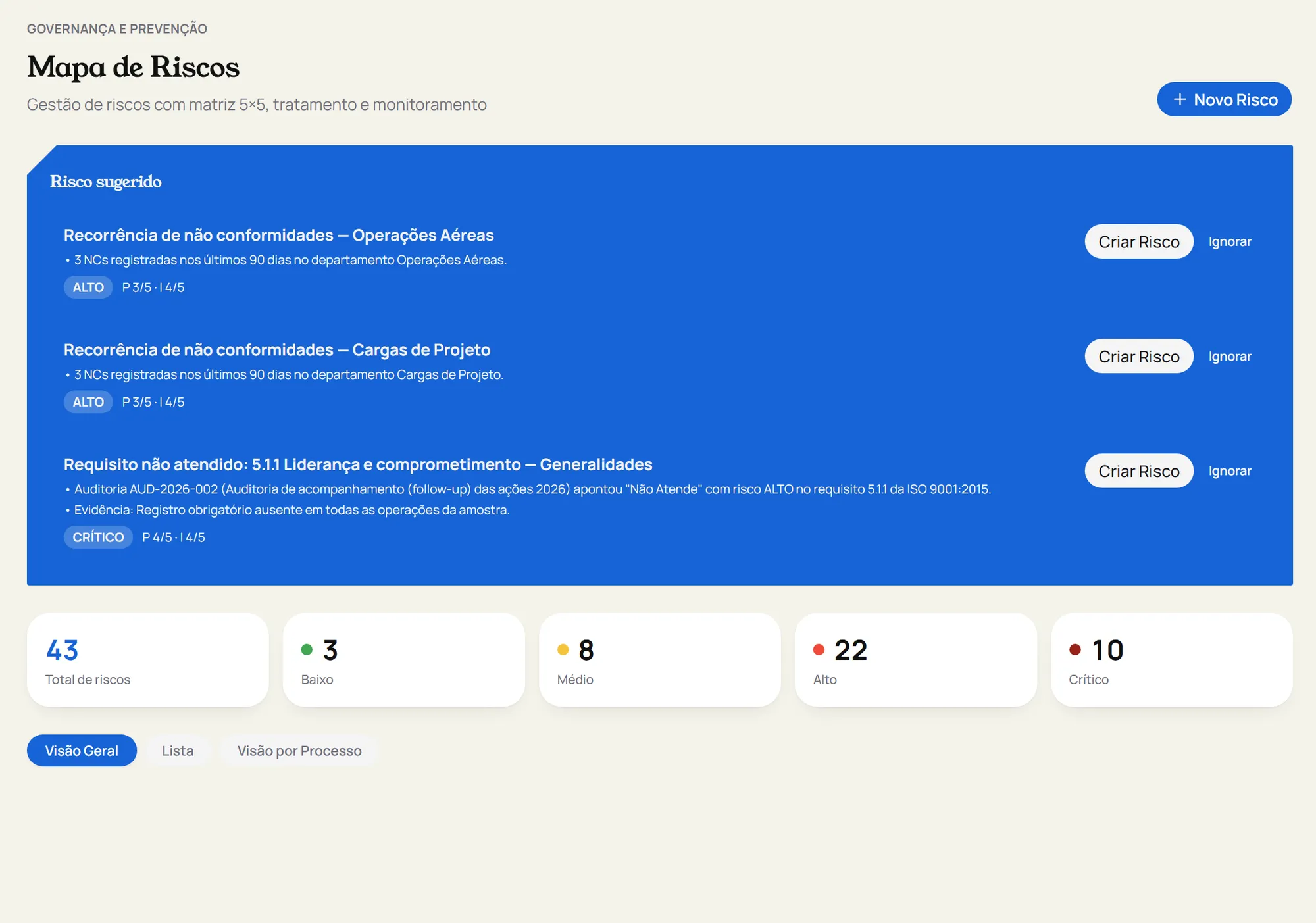
5×5 probability and impact matrix, inherent and residual risk, treatment with actions and deadlines, and alerts when a department piles up NCs.
Available on these plans
- Freenot included
- Starternot included
- Professionalincluded
- Businessincluded
- Enterpriseincluded
Why think about risk before the problem
Risk management means deciding where to put your attention before the problem happens. Measuring probability and impact helps you prioritize, and tracking the risk after controls shows whether the action actually reduced the exposure.
ISO 9001, clause 6.1: actions to address risks and opportunities.
From risk to control
Identify
Category and source: manual, audit, NC, OM or supplier.
Assess
Probability × impact sets the level: low, medium, high or critical.
Treat
Mitigate, eliminate, accept, transfer or share, with controls and actions.
Monitor
Residual risk, timeline, attachments and comments.
Day to day
Who operates
Receives treatment actions with deadlines and an automatic reminder when they are close to due.
Who leads
Sees the critical risks and gets a suggested risk when a department piles up NCs.
Who audits
Checks inherent and residual risk, controls and the timeline of each risk.
What comes with it
5×5 matrix
Probability × impact score with levels starting at 5, 10 and 15.
Inherent and residual
See the risk before and after controls.
Suggested risks
Automatic rules suggest a risk when a department reaches 3 or more NCs in 90 days, or when an audit flags a serious "noncompliant" with no risk created.
Actions with deadlines
Each action has an owner and a deadline, with automatic reminders.
Works together withNonconformitiesAuditsStrategic management
- What are the critical risks right now?
- What changed in my team’s risks?
- Suggest an action plan for this risk.
Explore the other modules
- Documents: Procedures, manuals and forms with drafting, consensus and approval, mandatory reading and a reminder before they expire.
- Incidents: Record the incident with evidence, follow the supervisor review and the Quality analysis, and see what it cost and how much can be recovered.
- Nonconformities: Handle nonconformities with 5 whys or Ishikawa, a 5W2H action plan and an effectiveness check. If it didn’t work, the NC goes back to root cause.
- Audits: Plan internal, external, customer and supplier audits, record findings with evidence and create an NC or improvement opportunity straight from the finding.
- Suppliers: Weighted questionnaire, Gold, Silver, Bronze or Rejected rating and re-evaluation on time. Suppliers answer through a link, no login needed.
- Disputes: When an incident has a dispute, it gets its own handling, with technical justification, BL number and carrier fee.
- Recovered value: Financial control of incidents shows the amount involved, what was recovered and what is still open.
- TAPI: TAPI adds up each employee’s losses over 12 months and suggests an action and a deadline for each band.
- Management reviews: ISO 9001 9.3 input topics created automatically, participants, decisions that become an NC or OM, and minutes in PDF.
Hover to preview each module. Click to learn more.
Start today.
Create your account on Free or try paid plans for 14 days.